In the battle between the Brain and the Heart, the Heart never fights fair and the Brain can never understand this. The Brain follows a strict code of conduct and expects it's opponent to do so as well. The Heart changes the rules and tactics as it goes to suit it's needs. The Brain lines up it's troops in orderly formations thinking time and again that reason will win the day. The Heart only acknowledges reason when it can use it to it's advantage. It takes hostages, ambushes with emotions and lays siege to thought.The Brain has elaborate strategy to minimize damage where the Heart is willing to sacrifice anything for it's cause, even itself. It fights like a true believer. The Brain negotiates and bargains. The Heart makes threats and demands. The Brain can surrender with grace and accept defeat, The Heart sulks and throws tantrums. The Brain is straightforward and honest in approach, the Heart, devious and manipulative. Facts and Logic melt like sugar before the flamethrower of "I WANT!". It seems the Brain can only achieve any form of victory when it's nemesis finally comes battered and exhausted to plead for mercy and help to extract it from the trap the Heart has built for itself and cannot get out of alone.
Thursday, August 25, 2011
Hearts and Minds
The battle is as old as humanity itself. It has raged on virtually unceasing since our species could first ask "Why?". The problem is, the fight is rigged.

Friday, August 12, 2011
Puppetry: The Fun Parts
A recent conversation with my college roommate Mike reminded me of something so simple and obvious that it is easily forgotten. I am one of the fortunate few. There are many out there more talented than I, or possibly more deserving, yet I am one of those rare lucky individuals who gets to do exactly what I want and get paid for it.
I realize that when I have discussed my professional life in this forum and in other places it has often been with a sense of exasperation or bemusement. At times when dealing with the arts and entertainment industries you can too easily become cynical and bitter about the fact you appear to be living in some sort of Absurdist literature. There are weird hoops to jump through, strange business procedures that seem designed to prevent you from getting ahead, and people to cope with who seem downright otherworldly.
Well this time I am not going to write about that at all. I shall not bemoan the fate I have chosen. There is to be no wailing and gnashing of teeth here. I will write about what I do and why I do it without cursing the gods or righteous indignation, no matter how funny I think I can make it. Without a single complaint about aching muscles or the near impossibility of earning a living wage I want to discuss the Art of Puppetry and why after all this time I still get excited when I am asked to put on a show
Okay. One Joke...and only because I wrote it!
Q: What do you call someone who works in the arts who has no business acumen, personal charm, or discernible talent?
A: Executive Director!
Part One: Planning and Design
Puppetry is really the art of problem solving at this stage. You figure out what you want to say and do and then try to figure out exactly how to make it happen. Does the character need to speak? dance? fly? Would this idea work best as a shadow show or mask work? What, in short are the specs? At this stage anything is possible. I love getting the most effect with simple, elegant solutions. My Art-School explanation of puppetry was that it is a form of minimalism. You strip away all that is unnecessary to get to the essence of what you want to say.
Part Two: The Build
If I were to be forced to pick a favorite stage in the process this would have to be it. Often for me it blends almost seamlessly with the design and planning. I feel this is where I make most of my discoveries. It seems almost literally magical. With scissors and hot glue, sheets of foam, fabric and leather transform into body parts which connect and become a whole new creature, waiting to come to life. I build with a method that I have, according to other puppeteers, invented that involves shaping and trimming the foam on the fly. It is a spontaneous, organic method of working where the results can often surprise even me !
Part Three: Rehearsal
If the Puppet comes to life during the building process, It develops a personality when you pick it up and manipulate it for the first time. The character traits I had attempted to portray solidify in this stage. Here is where my creation both literally and figuratively finds it's "voice". Once again this sounds like some sort of magic, but in reality, it is a form of play with a newly built toy. Not only do I discover what I want this specific character to do or say, hopefully I find any flaws to my initial design and can modify them or find a work-around before facing an audience. If other people are involved in the show, this is usually where they are incorporated. I find working with other performers changes my perspective and ordinarily enriches the experience.
Part Four: Performance
To be honest, this is the aspect that first attracted me to puppetry. You would think that eventually the thrill of stepping onto the stage would wear off, but all these years later, it's still just as fun. For just a moment, my bizarre creation comes literally alive to someone else. It is the best kind of illusion. You can understand exactly how it works and still be taken in. I find myself a willing dupe of other puppeteers along with the rest of the audience. So long as they don't do anything to break the spell, in the moment I am eager to suspend disbelief and go right along with them. This seems to be a universal truth. Everyone but the very young understands that the puppet is in reality, a moving doll, yet most people will play along for as long as you are willing to engage them. Performing a puppet is a wonderfully liberating experience. Puppets are allowed to say or do practically anything. There is no typecasting and few taboos. I can be more outrageous, crankier, sillier or more whimsical than I could ever get away with offstage. With the right puppet and the right voice I can turn into a senile old woman, a disgruntled parrot, or a clueless martian. In that moment my identity can vanish, and be replaced by something of my own devising, only to come surging back whole and undamaged the instant I put the puppet down. Best of all, I get to make people laugh, to tell them stories, to maybe give them a moment of enchantment. The money is not and will never be more than a pleasant side effect. I get paid in applause! Tell me if you can think of any better way to make a living!
I realize that when I have discussed my professional life in this forum and in other places it has often been with a sense of exasperation or bemusement. At times when dealing with the arts and entertainment industries you can too easily become cynical and bitter about the fact you appear to be living in some sort of Absurdist literature. There are weird hoops to jump through, strange business procedures that seem designed to prevent you from getting ahead, and people to cope with who seem downright otherworldly.
Well this time I am not going to write about that at all. I shall not bemoan the fate I have chosen. There is to be no wailing and gnashing of teeth here. I will write about what I do and why I do it without cursing the gods or righteous indignation, no matter how funny I think I can make it. Without a single complaint about aching muscles or the near impossibility of earning a living wage I want to discuss the Art of Puppetry and why after all this time I still get excited when I am asked to put on a show
Okay. One Joke...and only because I wrote it!
Q: What do you call someone who works in the arts who has no business acumen, personal charm, or discernible talent?
A: Executive Director!
Part One: Planning and Design
Puppetry is really the art of problem solving at this stage. You figure out what you want to say and do and then try to figure out exactly how to make it happen. Does the character need to speak? dance? fly? Would this idea work best as a shadow show or mask work? What, in short are the specs? At this stage anything is possible. I love getting the most effect with simple, elegant solutions. My Art-School explanation of puppetry was that it is a form of minimalism. You strip away all that is unnecessary to get to the essence of what you want to say.
 |
| Life sized Monkey. Modified Bunraku style puppet. Work in progress |
If I were to be forced to pick a favorite stage in the process this would have to be it. Often for me it blends almost seamlessly with the design and planning. I feel this is where I make most of my discoveries. It seems almost literally magical. With scissors and hot glue, sheets of foam, fabric and leather transform into body parts which connect and become a whole new creature, waiting to come to life. I build with a method that I have, according to other puppeteers, invented that involves shaping and trimming the foam on the fly. It is a spontaneous, organic method of working where the results can often surprise even me !
Part Three: Rehearsal
 |
| Performing Dog. Based on a Sicilian marionette Built for my "Circus" show (currently on hiatus until I can find funding) It took seven mop heads to make his coat! |
 |
| Throg, A Troll. Muppet style Hand puppet. This is possibly my most developed character. |
Part Four: Performance
To be honest, this is the aspect that first attracted me to puppetry. You would think that eventually the thrill of stepping onto the stage would wear off, but all these years later, it's still just as fun. For just a moment, my bizarre creation comes literally alive to someone else. It is the best kind of illusion. You can understand exactly how it works and still be taken in. I find myself a willing dupe of other puppeteers along with the rest of the audience. So long as they don't do anything to break the spell, in the moment I am eager to suspend disbelief and go right along with them. This seems to be a universal truth. Everyone but the very young understands that the puppet is in reality, a moving doll, yet most people will play along for as long as you are willing to engage them. Performing a puppet is a wonderfully liberating experience. Puppets are allowed to say or do practically anything. There is no typecasting and few taboos. I can be more outrageous, crankier, sillier or more whimsical than I could ever get away with offstage. With the right puppet and the right voice I can turn into a senile old woman, a disgruntled parrot, or a clueless martian. In that moment my identity can vanish, and be replaced by something of my own devising, only to come surging back whole and undamaged the instant I put the puppet down. Best of all, I get to make people laugh, to tell them stories, to maybe give them a moment of enchantment. The money is not and will never be more than a pleasant side effect. I get paid in applause! Tell me if you can think of any better way to make a living!
Sunday, August 7, 2011
Mona

The question to my mind, is not why did I decide learn music, but why I waited so long. Music more than any other art form seems magical, requiring a special God-given ability. Throughout my life I had always been half in awe and half envious of those who could open their mouths or take an instrument in hand and create so spontaneously. A week of trumpet lessons and an unsuccessful relationship with my high school chorus left me convinced that my sisters had all the musical talent in the family. Besides that, I was way too busy drawing or reading old stories or learning to track to have any time to practice. Maybe in my next life I'd learn to play something, but this time around I had far too much on my plate to add yet another unmarketable skill...Right?
Eventually I wasn't convinced by this argument either.

A week later in one of those inexplicable moments of serendipity, I found my fiddle. She was half concealed in a battered case in an antique shop. there were small body cracks in several places. The horsehair of the bow had been eaten at by carpet beetles. She hadn't been played in such a long time that the two intact strings were gut strings. I knew I was going to buy it, even before I consulted a friend who played fiddle. I still remember the first time I heard her voice. It was deeper and more resonant than I had expected, a sound that I felt in my marrow. I negotiated a fair price and took her to the local music store for repairs. Rarely have I regretted a purchase less. The luthier's eyes lit up when I opened the case. My new fiddle was a German made Amati copy violin from the 1930's. He showed me the inscription paper in the body that read "Nicholas Amatus Fecit in Cremona 1630 " and beneath that "Made in Germany" This and the noises I would probably be making for about the first year was what made me christen my new instrument "Mona". further conformation of my good fortune came the next day when I received an offer to buy my fiddle for at least twice what I paid from the shop's violin teacher. I politely declined.
 Learning to play has been a challenge, but less of one than I anticipated. I suspect this is because I never played an instrument with frets and so didn't have to unlearn any habits. I initially decided that I would put aside an hour a day to practice. This changed when I noticed how much time I was wasting by watching the clock. I now attempt to pick up the fiddle at least once a day, if only to play one tune. this is a far more attainable goal and I often find I play much longer than an hour without noticing. I have been playing for several years now. Recently I've noticed that I actually look forward to practicing. Playing tunes has become fun for me. I learn new music best from a combination of hearing the tune several times and sheet music. I'd like to train my ear a bit more so that I can pick up tunes just by hearing them. Most of what I play is traditional fare from Ireland and Scotland, with a few early American tunes thrown in for good measure. I love the intricate patterning of these songs as well as their evocative titles. To give just a few examples: Whiskey Before Breakfast, Soldiers Joy, The Road Lisdoonvarna. The Wind That Shakes the Barley, The Devils Dream, Ashokan Farewell and of course a catchy little tune called John Ryan's Polka! One of the weirder things to me about playing the fiddle, is that it still terrifies me to play in front of anyone. It is the one thing in my life that still gives me stage fright! Possibly because I'm still not very good yet...
Finally Here is one of my new favorite musician jokes:
What's the difference between a Violin and a Fiddle?

Sunday, July 31, 2011
Up to Eleven!
Gonzo: (To mirror) You're a reflection! You're supposed to do just what I do.
Reflection: But you do ludicrous things!
Gonzo: I do what?
Reflection: Ludicrous things!
Gonzo: Of course I do! I'm an ARTIST!
-The Muppet Show
Brewery Ommegang in Cooperstown has recently come out with a new beer called "Eleven By Volume". To commemorate this historic event, they asked me to carve them a custom tap handle in the shape of vertebrae. I eagerly accepted the commission. I really like this project for several reasons:
-It allows me to make a ridiculous yet functional object
- The project lets me indulge in my own highly specific form of geekery
-Ommegang, aside from making some really good beer, is a good company to work with. There was no petty quibbling over the cost or unnecessary interference in the design process. The deadline was realistically achievable
-Any commission that involves this kind of abysmal pun is one that I am wholly in favor of. (think about it!)
 For once, I thought to document my working process from beginning to end.
Here is the concept sketch. Ordinarily I don't draw out a carving first, preferring to discover it as I go along. Most clients, however, have this odd liking for what is quaintly called "having some idea what the hell we're spending the money on"
 I offered a variety of choices for the top of the handle. This detail is the one we all agreed upon. Personally I was lobbying for the ram skull...
 I chose to work with a piece of kiln dried maple 15 inches long and 2 and1/4th in. square. I chose maple because it has a subtle grain pattern, finishes nicely takes details well, and is durable enough for frequent handling.
 Sometimes I find it helps to roughly sketch out what I intend to do on the block first. During the carving process, you'll notice that I will occasionally draw a few crude lines to act as a guide.

 By the end of the first day, things are pretty well blocked out
 On the second day I roughed out where individual bones were to be

 On Day three, I concentrated on the top piece and separating the spines

 By Day Four you could see a nice curvature was emerging. I think this is also the day that I learned that if you listen to ear buds while working with a knife, it is an excellent idea to run the chord through your shirt.
 On the Fifth day of work I am entirely finished carving and have put the hardware on. The only reason this was photographed in a studio setting was that it happened to be raining at the time.


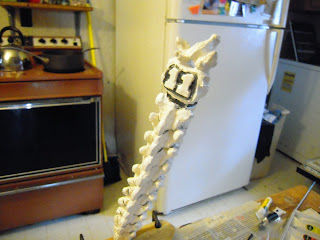 Here is the tap handle halfway through the painting process.
 Sometimes you simply don't have the amount of drying time recommended on the back of the can of finish. I think this is one of my more inventive Jury-rigs.

 And finally, the finished product! Say it with me: "This Is SPINAL TAP!"
 Note that there are 10 bones under the top piece. This actually does go up to eleven! (I even numbered it )

 Hopefully soon I will have some pictures of this installed and in use.
Reflection: But you do ludicrous things!
Gonzo: I do what?
Reflection: Ludicrous things!
Gonzo: Of course I do! I'm an ARTIST!
-The Muppet Show
Brewery Ommegang in Cooperstown has recently come out with a new beer called "Eleven By Volume". To commemorate this historic event, they asked me to carve them a custom tap handle in the shape of vertebrae. I eagerly accepted the commission. I really like this project for several reasons:
-It allows me to make a ridiculous yet functional object
- The project lets me indulge in my own highly specific form of geekery
-Ommegang, aside from making some really good beer, is a good company to work with. There was no petty quibbling over the cost or unnecessary interference in the design process. The deadline was realistically achievable
-Any commission that involves this kind of abysmal pun is one that I am wholly in favor of. (think about it!)
 For once, I thought to document my working process from beginning to end.
Here is the concept sketch. Ordinarily I don't draw out a carving first, preferring to discover it as I go along. Most clients, however, have this odd liking for what is quaintly called "having some idea what the hell we're spending the money on"


 By the end of the first day, things are pretty well blocked out


Friday, July 29, 2011
Filler

Her name is Cecelia. She is an African Fat-tailed Gecko.

 You can see why they are called that.

Well, that's about it. Thanks for tuning in.
Thursday, July 28, 2011
The Donkey on the Stairs, Explained and Illustrated

So here it is at long last, The reason this blog is called "The Donkey on the Stairs" (Although to boost readership, I'm considering changing it to "It's Got Lots of Pictures") :
When I was travelling I started my first blog, Tourist Monkey to keep everyone updated on my travels. One curious thing about travel writing is when monkeys are stealing your luggage or you're crammed uncomfortably on a bus with 59 unwashed people, or something generally unpleasant is happening to you, it's remarkably easy. When you are happy and at peace, writing about your adventures becomes very difficult because nothing, from a purely narrative perspective, is happening. It was exactly this predicament I was facing in Bhagsu, an extremely pretty and peaceful little Himalayan town in India. On one beautiful sunny morning I was walking to my favorite breakfast place. As I strolled downhill watching the blue magpie flip back and forth between the trees, with their long streamer-like tails and vaguely suspicious expressions that made them look like fugitives from a story book illustration, I was thinking that I was overdue to post an entry. Just as I was thinking that I had nothing at all to write about I stepped out of the way of a train of donkeys. It should be mentioned that most of Bhagsu's streets are actually a series of narrow staircases because the terrain is so steep. No wheeled vehicle could manage them. The only way to get supplies up and down the mountainside is with pack ponies or donkeys, Trains of these animals march up and down the hill all day. On average you would have to stand aside and wait for them to pass five or six times a day.If i hadn't been thinking about writing home, it simply would have never occurred to me that there was anything unusual about this and I might have never mentioned it. It got me thinking about all the other things I accepted as commonplace that would seem exotic and strange to an outside observer. I had very little trouble writing that entry.
For the most part I think that I lead a fairly ordinary life, yet I am a professional puppeteer and artist. These are not exactly common career paths. My morning routine involves misting lizards and putting fresh greens in the bird cages. I think upon closer inspection, most people could find something unusual and interesting in their day to day routine. On the whole, ordinary life is an extraordinary thing! I chose this title to remind myself of this.
When my sister asked me about the title, she asked why I called the blog "The Donkey on the Stairs" and not "The Capybara in the Cupboard". This struck me as really funny for some reason:


On a completely unrelated note, I was chatting with my friend Gennarose the other day.( Aside from being a wonderful human being, Gennarose may just be the single most talented person I know, which is really saying something!) During the course of conversation, she announced "I hate singing rodents! unless they're singing opera. Then that's just classy" (It actually makes sense in context). Then, this happened:

Apparently, you should really be careful what you say around me....
Thursday, June 30, 2011
Underlying Form

 Here we have my Canid collection. From smallest to largest: Red fox (Vulpes vulpes),North Eastern Coyote (Canis latrans thamnos), and Feral Dog (C. lupus familiaris). I find it really interesting to be able to compare these closely related species with one another. Note the bullet hole in the coyote's cranium. I found her along a farmer's fence row. It should be mentioned that there is a chance that the bottom skull is possibly a coyote/dog hybrid, judging by how deep in the woods I found it. It is very difficult to tell from morphology alone.
 This is the one most likely to get me in trouble with people. It is a Domestic Cat. (Felis cattus). This specimen was hit by a car. I didn't want somebody's beloved pet in my collection, so I made absolutely certain that he was a stray before I took it. I just love how compact the jaws are and those fantastic large sockets.
The whole skull has a pleasing round form


This is one example of why comparative anatomy is so intriguing to me. On the left is the North American Beaver (Castor canadensis) and the one on the right, the Common Porcupine (Erethizon dorsatum) These are the two largest rodents in North America. They are from entirely different branches of the Rodent family. One is adapted to aquatic life and the other is largely arboreal, and yet, their skulls are remarkably similar because they eat the same type of plant matter.

This one was on my wish list for a very long time. It is hard to find an intact skull of the Eastern Cottontail (Sylvilagus floridanus) because most animals that eat them aim for the head. I found this about a quarter mile from the cat, and on the same day. Sometimes you just get lucky. A rabbit's skull has a surprisingly aggressive character for such a timid animal.


The only native marsupial in North America, the Virginia Opossum (Didelphis virginiana) has the most teeth and smallest braincase of any mammal on the continent. I really like the sleek looking zygomatic arches (cheekbones) and large sagital crest on this specimen. I think it may have been quite young when it died.
When I want to stump someone, I usually try to have them guess what this next one is. Very few people could tell without being told first that this wonderful piece of Gothic architecture is what's found beneath the jowls and floppy ears of the Domestic Pig (Sus scrofa domesticus).


I probably have more Whitetail Deer (Odocoileus virginianus) skulls than anything else. The one depicted here is neither my best specimen or my most interesting, but she was one of the first skulls I found and the one that really got me started on my morbid little hobby. Deer skulls seem very graceful to me


Well, that's all for now. I hope you enjoyed seeing some of my collection nearly as much as I liked showing it to you
Subscribe to:
Posts (Atom)